Sunday

crowdfunding


What is Crowdfunder? 

Crowdfunder is an innovative funding platform helping project owners' ideas become realities across the UK and Europe.  
Launched in November 2010, Crowdfunder is one of the UK's leading rewards based crowdfunding platforms after merging with Peoplefund.it. To date the Crowdfunder network has raised over £500,000 for great ideas, people and projects in process. The 
We’re also working with a number of partners including NESTA, Forum for the Future, Unbound, Peoplefund.it, WeDidThis, Project Dirt and Enterprise Nation. 
Whether your project is big or small, hare-brained or thoughtful, serious or just for fun - we want to hear from you. Crowdfunder aims to fund all sorts of crazy, arty, funny, ingenious and jaw-dropping projects. So if you’re an artist, explorer, musician, writer, entrepreneur or thrill seeker get in touch and kick start your project with Crowdfunder today.


How does Crowdfunder work? 

 How crowdfunding works
Lots of people – each giving a small amount – can make good things happen.  The ‘crowd’ decides what’s good, what’s not, what they want to fund and what they don’t.  If the crowd doesn’t back the project it won’t happen. 

Project owner?

We give creative people the platform to raise cash for their ideas. It's a great way to gain a massive fan base and test your idea out on the crowd, thus validating your idea. A fun, easy and fast way of raising money without borrowing from the banks. 
It couldn't be easier to raise money. All you need is a good idea, five tangible rewards, a short project video explaining what your project is and most importantly passion. 
All project owners offer rewards to investors in return for pledges from as little as £1. And if you don't hit your target you don't get charged. 
Did we forget to mention it's free to add a project, so what are you waiting for? 

Backer?

We love letting people back projects that are close to their hearts which is why we have made it super easy for you to invest in a project. 
 In return for funding a project you’ll get a reward from the project owner.  This could be anything from a ‘big thank you’ to a one off tailored reward just for you, both the project owner and backer win. 
We take payments via PayPal but you don't need a Paypal account to do this. Just go through the Account set up process and then click on the appropriate debit or credit card link and you can pay that way.
We also take Direct Debit payments via Go Cardless. 
 Go ahead and fund a project today, there's loads of cool rewards waiting for you.

Other Company`s

After researching information about crowdfunder i wanted to research further and explore numerous company's that offered the same. I thought by doing this it would enable me to decided which fund raiser would be best for me. The other two company's i researched where kickstarter and indiegogo.

KickStarter


Kickstarter is a new way to fund creative projects.
We’re a home for everything from films, games, and music to art, design, and technology. Kickstarter is full of projects, big and small, that are brought to life through the direct support of people like you. Since our launch in 2009, more than 3.9 million people have pledged over $587 million, funding more than 40,000 creative projects. Thousands of creative projects are raising funds on Kickstarter right now.
Each project is independently created.
The filmmakers, musicians, artists, and designers you see on Kickstarter have complete control over and responsibility for their projects. Kickstarter is a platform and a resource; we’re not involved in the development of the projects themselves. Anyone can launch a project on Kickstarter as long as it meets our guidelines.
Together, creators and backers make projects happen.
Project creators set a funding goal and deadline. If people like a project, they can pledge money to make it happen. Funding on Kickstarter is all-or-nothing — projects must reach their funding goals to receive any money. All-or-nothing funding might seem scary, but it’s amazingly effective in creating momentum and rallying people around an idea. To date, an impressive 44% of projects have reached their funding goals.
“ There’s just something magical about Kickstarter... You immediately feel like you’re part of a larger club of art-supporting fanatics.”


Creators keep 100% ownership of their work.
Backers are supporting projects to help them come to life, not to profit financially. Instead, project creators offer rewards to thank backers for their support. Backers of an effort to make a book or film, for example, often get a copy of the finished work. A bigger pledge to a film project might get you into the premiere — or a private screening for you and your friends. One artist raised funds to create a wall installation, then gave pieces of it to her backers when the exhibit ended.
Creative works were funded this way for centuries.
Mozart, Beethoven, Whitman, Twain, and other artists funded works in similar ways — not just with help from large patrons, but by soliciting money from smaller patrons, often called subscribers. In return for their support, these subscribers might have received an early copy or special edition of the work. Kickstarter is an extension of this model, turbocharged by the web.
 "The most democratic way art has ever been made.”
Stephen Heleker Kickstarter
Backing a project is more than just giving someone money.
It’s supporting their dream to create something that they want to see exist in the world. People rally around their friends’ projects, fans support people they admire, and others simply come to Kickstarter to be inspired by new ideas. Some projects take longer than anticipated, but creators who are transparent about issues and delays usually find their backers to be understanding.
Our mission is to help bring creative projects to life.
We’re a for-profit company based in New York City’s Lower East Side. We spend our time making Kickstarter a little bit better every day, answering questions from backers and creators, and finding new projects to share. If a project is successfully funded, we apply a 5% fee to the funds collected.
We believe that creative projects make for a better world, and we’re thrilled to help support new ones. After 35,000+ successfully funded projects, we know that building a community of backers around an idea is an amazing way to make something new.
indiegogo.

Raise Money

  • Everyone should have the opportunity to raise money. Now everyone does. People all over the world use our industry-leading platform to raise millions of dollars for all types of campaigns. No matter what you are raising money for, you can start right now with no fee or application process.

Create Your Campaign - It's Simple

  • At Indiegogo, creating a campaign is simple. Tell people what you are doing, how they can help and what unique perks they'll get for becoming contributors. You keep 100% ownership of your campaign and you don't owe us a cent until you raise money. Our customer happiness team is here to make sure you have the support you need any time of day.

Gain Global Exposure

  • Indiegogo helps you spread the word about your campaign with a unique algorithm we call the gogofactor. Use our powerful social media tools when you launch your funding campaign and start sharing, tweeting, and encouraging people to 'like' your campaign to boost your gogofactor. Raise it enough and you could be featured on our homepage or in the press!

Get Inspired

  • Browse the thousands of amazing campaigns on our site to find your inspiration. Discover something new, contribute to a campaign and join the tens of thousands of people who use Indiegogo every day.

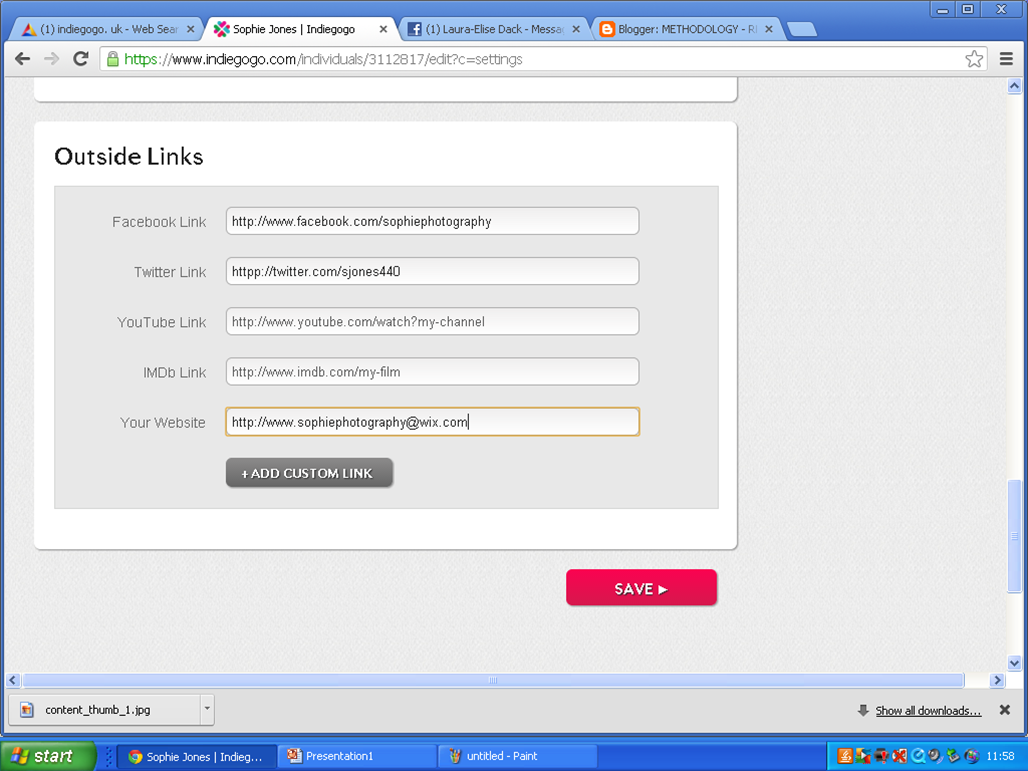
    After researching all three company's i made a funding page with Indiegogo. I chose this company as i was interested and intrigued how it helps you spread the word about your campaign. I thought it would be good to use their social media tools when i launch my funding campaign as i could start sharing, tweeting, and encouraging people to 'like' my campaign and boost my gogofactor. Plus if i raise enough i could be featured on their homepage or in the press! Which would really benefit my project and help start build my photography career.

    Starting up my funding page on Indiegogo.


     What i wrote on my home page...

    My work creates ethical fashion with a sense of right and wrong? It explains and emphasizes the importance of the global and personal benefits of adopting these practices, and demonstrates the ways in which individuals, can make conscious changes in their wardrobe choices, reducing their environmental impact of 'waste couture' on our planet.
    i would require funding in order to develop and research recycled fashion. This would enable me to guarantee that my prints would be of a suitable standard of quality for magazine publication. 
    Any donations will help me to achieve my goal and in return, will receive an A4 print of your chosen photo from my recycled fashion photography project. 
    (If you chose to pledge £10, you will receive a free handmade designed recycled item of clothing)
    thank you very much and I hope you will support me, please send me an email with your name and address after pledging so I can contact you regarding your A4 print or gift, and send it to you! My email adders is : sophie440@hotmail.co.uk
    ABOUT SOPHIE JONES
    Sophie Jones is a photographer studying a Bachelor Degree in photography: Contemporary Practice in Rochester, UK; based mainly in Kent. She specializes in portrait and fashion photography, however also enjoys many other aspects including, nature, landscape and documentary. Sophie has explored both digital and analogue photography through out her degree and in previous work, utilizing aspects of both forms. She has dealt with themes of fashion greatly during her time at university, connecting to the subject through personal experience, thoughts and politics, and self opinions. Since starting her degree, Jones has taken on several commissions in the field of fashion as well as still life, landscape and documentary, some of work photography has been featured on websites and in public exhibitions, and this time a fashion magazine. 


workshops


WORKSHOPS


  • 14:00-17:00 Catch up studio lighting workshop. Studio three, Colin.

    Another good catch up session and a chance to try the beauty dish and ring flash I’ve never used before. Some good points one of which being the setting and metering of individual lights, always starting with the main light, a really good practice. We went over the use of a fill, making the background white (and black). A reminder of how to set up the Broncolour system, including the use of the cell function.

  • Final Cut Pro workshop

I found this workshop really interesting and useful as we recapped the last sessions we had learning about the software.

Below is some information I learnt whilst experimenting and learning with the software.
About Final Cut Pro

Final Cut Pro is a non-linear video editing software developed by Macromedia Inc. and later Apple Inc. The most recent version, Final Cut Pro X, runs on Intel-based Mac OS computers powered by OS X version 10.6.8 or later. The software allows users to log and transfer video onto a hard drive (internal or external), where it can be edited, processed, and output to a wide variety of formats. Since the early 2000s, Final Cut Pro has developed a large and expanding user base, mainly video hobbyists and independent filmmakers. It had also made inroads with film and television editors who have traditionally used Avid Technology's Media Composer. According to a 2007 SCRI study, Final Cut Pro made up 49% of the US professional editing market, with Avid at 22%. A published survey in 2008 by the American Cinema Editors Guild placed their users at 21% FCP (and growing from previous surveys of this group), while all others were still on an Avid system of some kind.

Browser

As in most digital non-linear editing applications, the Browser is not an interface to the computer's file-system. It is an entirely virtual space in which references to clips (aliases) are placed for easy access, and arranged in folders called 'bins'. Since they are only references to clips that are on the media drive of the computer, moving or deleting a source file on the media hard drive destroys the link between the entry in the Browser and the actual media. This results in a 'media offline' situation, and the media must be 'reconnected'. Final Cut Pro can search for the media itself, or the user can do this manually. If multiple clips are offline at the same time, Final Cut can reconnect all the offline media clips that are in the relative directory path as the first offline media clips that is reconnected.
The browser has an 'effects' tab in which video transitions and filters can be browsed and dragged onto or between clips.


Canvas

The canvas outputs the contents of the Timeline. To add clips to the Timeline, besides dragging them there, it is possible to drag clips from the Browser or Viewer onto the Canvas, whereupon the so-called 'edit overlay' appears. The edit overlay has seven drop zones, into which clips can be dragged in order to perform different edits. The default is the 'overwrite' edit, which overwrites at an in point or the space occupied after the playhead with the incoming clip. The 'insert' edit slots a clip into the sequence at the in point or playhead's position, keeping the rest of the video intact, but moving it all aside so that the new clip fits. There are also drop zones to have the application automatically insert transitions. The 'replace' edit replaces a clip in the Timeline with an incoming clip, and the 'fit to fill' edit does the same thing, but at the same time, it adjusts the playback speed of the incoming clip so that all of it will fit into the required space [in the Timeline]. Finally there is the 'superimpose' edit, which automatically places the dropped clip on the track above the clip in the Timeline, with duration equal to the clip below it. Unless an in or out point are set, all edits occur from the position of the playhead in the Timeline.
Using the wireframe view on the canvas, the clip can be manipulated directly - dragging it around in the canvas to change its position, for example, or resizing it. Precise adjustment controls for these things are in the viewer.

Viewer

The viewer has tabs for each channel of the selected clip's audio, in which the waveform for the audio can be viewed and scrubbed, and where its volume can be keyframed. The filters tab is where effects for the clip appear and where their parameters can be adjusted and keyframed. If the clip selected is a generator (such as an oval shape), a control tab appears for changing its geometrical properties. Finally, the viewer's motion tab contains tools to adjust the scale, opacity, cropping, rotation, distortion, drop shadow, motion blur and time remapping properties of a clip. Mini-timelines to the right of each parameter allow the property to be keyframed. The Viewer is not present in Final Cut Pro X.

Timeline

Clips can be edited together in timelines called sequences. Sequences can be nested inside other sequences, so that a filter or transition can be applied to the grouped clips.
The Timeline in Final Cut Pro allows 99 video tracks to be layered on top of each other. If a clip is higher [in the timeline] than another, then it obscures whatever is below it. The size of a video clip can be altered, and the clips can be cropped, among many other settings that can be changed. Opacity levels can also be altered, as well as animated over the course of the clip using keyframes, defined either on a graphical overlay, or in the Viewer's 'motion' tab, where precise percentage opacity values can be entered. Final Cut also has more than a dozen common compositing modes that can be applied to clips, such as Add, Subtract, Difference, Screen, Multiply, Overlay, and Travel Matte Luma/Alpha.
The compositing mode for a clip is changed by control-clicking or right-clicking on the clip and selecting it from the cascading contextual menu, or by selecting the mode from the application's 'modify' menu. For either matte modes, the clip that will perform the key is placed overneath the fill clip on the Timeline.
For more advanced compositing Final Cut Pro is compatible with Apple's Shake (discontinued) and Apple Motion software.

Keyboard shortcuts

Final Cut Pro uses a set of hot-keys to select the tools. There are almost 400 keyboard commands that allow the user to increase the speed of edits. This combined with the nonlinear approach that digital editing, provides Final Cut Pro users with several editing options.
Users can also set their own customizable keyboard preferences.

  • Dream Weaver workshop

Unfortunately due to number of students, this workshop was cancelled and was due to be re-scheduled for another time. But have not heard of any re-scheduling, so decided to do download the software and learn and experiment with the program.
Adobe Dreamweaver is a web development application developed by Adobe Systems.

About Dreamweaver

Adobe Dreamweaver is a web design and development application that provides a visual WYSIWYG editor (colloquially referred to as the Design view) and a code editor with standard features such as syntax highlighting, code completion, and code collapsing as well as more sophisticated features such as real-time syntax checking and code introspection for generating code hints to assist the user in writing code. The Design view facilitates rapid layout design and code generation as it allows users to quickly create and manipulate the layout of HTML elements. Dreamweaver features an integrated browser for previewing developed webpages in the program's own preview pane in addition to allowing content to be open in locally installed web browsers. It provides transfer and synchronization features, the ability to find and replace lines of text or code by search terms or regular expressions across the entire site, and a templating feature that allows single-source update of shared code and layout across entire sites without server-side includes or scripting. The behaviors panel also enables use of basic JavaScript without any coding knowledge, and integration with Adobe's Spry Ajax framework offers easy access to dynamically-generated content and interfaces.
Dreamweaver can use third-party "Extensions" to extend core functionality of the application, which any web developer can write (largely in HTML and JavaScript). Dreamweaver is supported by a large community of extension developers who make extensions available (both commercial and free) for most web development tasks from simple rollover effects to full-featured shopping carts.
Dreamweaver, like other HTML editors, edits files locally then uploads them to the remote web server using FTP, SFTP, or WebDAV. Dreamweaver CS4 now supports the Subversion (SVN) version control system.


·         16:00 Tech Talk Bjorn Veno: Lightroom

 https://www.youtube.com/user/adobelightroom

15/Feb/2013 Bjorn Veno Tech Talk: ‘Lightroom’

Despite not being booked to attend the advanced Lightroom workshop i felt i needed to attend this session as i have no experience of using Lightroom at all, and i knew the advanced session would be too advanced for me therefore. I have recently purchased Lightroom so the session was of real help in understanding what the software was able to do.

  • Mon 18th February 2013 Advanced Lighting Workshop: Colin Studio One 14:00- 17:00

Today’s workshop started by setting up some a two light setup.

Aperture setting to be achieved was F8 (selected because it was a good middle ground aperture from which the lights could be adjusted from)

Two gobos with reflectors affixed with clamps. The lights (broncolour) fitted with dishes were aimed at the boards. The boards were set at about 45 degrees and the reflected light illuminated both sides of the sitters face and torso. Result an overall even lighting effect, with a grey background and separation between sitter and background.

Further combinations of lighting were demonstrated and those included:

Adding extra gobos to effectively create a box (two walls of gobos wither side). Four heads were used with umbrellas and ‘C stands’ using white material to diffuse the light (hung from C stands). Two broncolor units were used, with the top two heads attached to one, and the bottom two attached to the other. The reasoning behind this being that you can adjust the levels of either upper or lower segments independently. This gave an even overall light. Rotating the gobos (to face the black side to the lights) darkened the backdrop by reducing reflected light. Turning the gobos al slightly increased modelling on the face.

Back-lighting was demonstrated with continuous lighting.  A single rear continuous light (T2 Arri) was then brought in, aimed forward toward the models back to demonstrate how the light spills over the edge of the model. Also to demonstrate how this lighting effect creates separation from the background. A single front light (broncolor flash) with honeycomb attached lit the front (placed in an elevated position). Various changes were demonstrated such as changing the models to demonstrate the effect of dark or light clothing on reflected light. This reflected light altered the background quite dramatically. To exaggerate the effect a white sheet was affixed to the back of one model.

Duel softboxes were also demonstrated to show the even lighting effect.
Further lighting techniques included switching the rear Arri light to face the camera and leaving it in shot (and also adding a second light). The rear (forward facing) light was purely used for dramatic/cosmetic effect and not for its lighting output.
Workshops i`ve missed! But collected notes from other students….

  • Photoshop - Feb/2013 10:00 – 12:00

    Photoshop session with Bjorn Veno.

Due to competing in an international in Oberstdorf Germany I was unable to attend this workshop, but gathered notes from other students.

I heard this session went back over the re-touching session we’d previously had.
Students had found this session really useful, and helped with confidence and their enthusiasm to delve into the digital world increases.

  • 10-13:00 Cyanotype workshop with Riike:

Today (28/Jan/2013) was the cyanotype workshop with Riike. I would of liked to have gone but unfortunately i had other commitments so wrote notes about the workshop.
.
This workshop I heard was a really fun and simple process that created an interesting effect. The chemical solution is applied in two layers (dried between applications) and then a neg or acetate is affixed to the surface (emulsion to emulsion). Exposure is achieved by placing the paper and neg under glass and exposing it to UV light. Exposure time was about 20 minutes on a UV bed. The chemicals are then washed off in water and the prints left to dry. Paper is usually a water-colour type, but any paper that can take the chemical and survive the wash can be used.

  • Workshop: 6th Mar 2013 Colin Jackson.
Hand Processing Film.

Unfortunately I could not attend this workshop, but I gathered some notes from student who did attend, and found the session really interesting and therefore would like to experiment in the future.

Notes

Once you have exposed your film, it is important that no further light gets to it, so the first operation is performed in total darkness.
To reveal the images, the film needs to be immersed in a sequence of three chemicals, so firstly it is wound on to a spiral and placed in a light-tight developing tank. The spiral holds the film so that the liquid chemicals can act on all surfaces of it.
Once the lid is on the developing tank, the next operations can be carried out in light.
The sequence of chemicals is:

<!--[if !supportLists]-->1.       <!--[endif]-->Developer
<!--[if !supportLists]-->2.       <!--[endif]-->Stop Bath
<!--[if !supportLists]-->3.       <!--[endif]-->Fix


 Developer
Find out how long your particular film needs in the developer you are using and the quantity required.

Dilute the developer according to the instructions.
·                       Ilfosol 3 is diluted 1:9 with water at 20 degrees C.
·                       Pour it into the developing tank and start the timer.
·                       Agitate the tank for ten seconds when you have sealed it [four slow inversions] and again at the same point in every minute of the developing time.
·                       At the end of the developing time remove the tank seal and pour out the developer.
·                       The developer has revealed the images and darkened them to the correct tones.
Stop Bath
Pour a measured quantity of stop bath into the tank, leave for 30 seconds agitating occasionally, then pour it back into the container. The stop bath is used as a buffer between the developer [alkali] and the fix [acid].It helps to keep the fix fresh and active.

Fix
Pour a measured quantity of fix into the tank, seal it and zero the timer. You need to fix for 5 or 10 minutes, depending on the type of film. You should agitate every minute as you did with the developer.
The fix dissolves any silver not affected by light during exposure and renders the film insensitive to any further light, making it permanent. The fix should then be returned to the container.

Wash
Keeping the film on the spiral, wash it in running water for 10 minutes. It can then be agitated in wetting agent, removed from the spiral and dried.


Methodology output


articles associated with recycling fashion

Before starting my fashion editorial, I decided to research several articles that were associated with recycling fashion. I thought this would be a good starting point, as I could gain a greater understanding of fashion layouts and gain ideas on what type of articles I should research for further inspiration.  
 
 - dazed and confused magazine issue 9
-http://www.positive-magazine.com/download/
 - Vogue
Livia Firth - Upcycling With Ms Minetti


Theme, target audience and name
Theme

Fashion magazine based on recycling and upcycled fashion, stopping mass consumption. 

I want to try and explain how the fashion industry encourages audience's to recycle and up - cycle clothing.
I want to emphasize the concept of how waste links into the fashion industry, and how certain problems involving the issue of waste could be solved? All images used are all fashion based, which helped me decide what output I wanted to explore and create? The fashion magazine inspired me the most, and therefore decided my output would be a fashion magazine showcasing how the public audience can still be fashionable yet environmentally friendly at the same time. The concept of my magazine is to encourage clothing recycling and upcycling to help stop mass consumption in the fashion industry.

Name

To gain inspiration on what i could call the magazine, I looked up names in the saurus to see what words are associated with recycling.

recycling:
- convert
- reclaim
- recover
- reprocess
- salvage
- save
- reuse
-Trashfashion

Other names I thought of are:
- Eco
- Environmental


Name of magazine, ‘Trashfashion’

i decided that this name was suitable for my output as the name identifies the theme of the magazine. The name is short so can easily be remembered, and from looking back at research short names are considerably popular.  


Target audience and style

-Target Audience
16- 30 is the target audience that i have selected for my magazine. I thought by selecting this age group it  focus's on the next generation, encouraging them to recycle regularly.  

- Style
Modern, minimalistic and powerful! The style of magazine I hope to create has to be seen as modern. I want this to appeal to the younger target audience. The style will also represent a  minimalistic theme, so all the attention is kept on the images showcasing how fashion can be recycled. Throughout the magazine I want to refer back to my reference `positive magazine` and how they use the `+ sign` through out the spread. This is how I came up with the idea of having the recyclable logo on the top of every left page. 


why `positive magazine` inspired me?
The reason why I chose to research `Positive Magazine` was because i wanted my work to be seen in a similar format covering photos, stories, reportage's  every fragment that tells what’s happening in the world through different points of view. I really admire how the magazine dealt with topics that are happening in the world, and felt this type of magazine would relate well towards my topic which deals with recycling in the fashion industry. I also appreciated the modern feel the magazine had, and how they used different page layouts throughout the editorial.

Whereas the magazine PDF format `dazed and confused` was seen as a more formal layout featuring topics such as music, fashion, film, art, and literature. I would like my magazine to capture the awareness of recycling and therefore did not want the design to be seen as formal. Due to this matter i thought about researching the Stitch newspaper, as it was viewed as an awareness pack to generate a change of attitude and behavior towards clothing care.


ideas for magazine from `positive magazine`

Images at top of page


- Images placed at the bottom of page

- Title of article covering one whole page
Using the whole page as an image. I like the idea of using the whole of the page for an image as if to say we are not wasting the paper and are recycling...
- Repititon of images
- Black backgrounds, match images
-Text on double page
- Collage, the images have been placed in a collage style where they are layered on top of each other.

artist typography research

artist typography research

For inspiration and ideas I researched into typography references and began my research with English graphic designer, typographer and art director Neville Brody. His work mainly includes publication's with articles relating to typography and surrounding subjects. The designs and fonts that he creates are unique and revolutionary in some shape or form. I found his work interesting especially how he designs the text so larger fonts are mixed in smaller fonts, creating certain words. I think these designs stand out and grab the public's attention, this is a technique we as a group have used in our editorial magazine.
Erik Spiekermann is a German typographer and designer. Throughout his career he has created dozens of commercial typefaces and many custom typefaces for world-renowned corporations.


David Carson 
David Carson is also a graphic designer. I found his work interesting to look at as his work has been described as being 'grunge typography'. I would agree with that statement as some of his images look as if they have been ruined purposefully. He also places text on images the same way by having missing letters and having them scattered unevenly.

Stefan Sagmeister

Sagmeister is another graphic designer and typographer. He`s designed album covers for artist`s such as Aerosmith, The Rolling Stones and OK Go. Sagmeister has also worked for many magazines since the age of 15 and now designs packaging, branding, graphics and books. From research, his imagery made me realize how important typography is, and how  the style can change the whole layout and narrative just by using certain styles and designs. I think his work is inspirational, especially how he uses layers on top of text. I think this could work effectively and fit with the approach, we as a group are trying to perceive.

general ideas for magazine...


An idea for my magazine page layouts .....


I wanted my images to resemble a striking display, deconstructing, re-cutting and completely transforming people’s perception of second-hand clothing or recyclable material, and create ethical fashion with a sense of right and wrong?

For my page layout i would like to portray a similar style as the magazine issue ` the black swan issue` (little white lies). I really liked how the designer has placed font over the original image. The design looks unique yet contemporary and stylish. I also referred to my other chosen research magazine `positive magazine`. Their page layouts where simple yet intricate. I would like to create something similar, so the viewer could clearly understand my work.

When researching I have chosen references that relate to my project, as I believe my self and designers have portrayed environmentally conscious trends in fashion. I want to explain the global and personal benefits of adopting these practices, and have demonstrated ways in which individuals, can make conscious changes in their wardrobe choices and reduce their environmental impact of “waste couture” on our planet.

For my article i want to state the fact that there’s a growing trend among clothing manufacturers who are turning all kinds of trash into fashion these days.  Old signs and office chairs, they’re all being recycled into clothes that are sold by well-known retailers. “Our evolution toward using trash as our supply chain came through our desire to reduce the impact our clothing has on the planet,” said Jen Rapp, director of communications and public relations for Patagonia, the Ventura-based manufacturer that is largely credited with birthing, then mainstreaming, the trash-to-fashion trend.


Why i would chose to use text over image?
For some of my page layouts i have tried to portray a similar style as the magazine issue ` the black swan issue` (little white lies). I really liked how the designer has placed font over the original image. The design looks unique yet contemporary and stylish. I also referred to my chosen research magazine `positive magazine`. Their page layouts where simple yet intricate. I wanted something similar, so the viewer could clearly understand my work.


Research for designs of Contents Page
Contents Page


front cover idea?


If i was to create a back cover i like the idea of having the same images as what I used for the front cover, as i would like to create the illusion as if the reader has completed a full circle to represent the term `recycling`. The repetition of the images symbolize recycling and up-cycling to give the audience the idea of  recycling the magazine. This idea was mainly inspired by the back pages of `Positive magazine`. 


Recycling article for indesign magazine

For my methodology output i have decided to collaborate with another group and create a fashion magazine, involving my prints and an article based around my concept.
Below is the article that i wish to involve within the magazine....


It is estimated that more than 1 million tonnes of textiles are thrown away every year in the UK alone. At least 50% of the textiles we throw away are recyclable, however, the proportion of textile wastes reused or recycled annually in the UK is only around 25%.
Recovery and recycling provide important environmental benefits. Textile recovery:
·         Reduces the need for landfill space. Textiles present particular problems in landfill as synthetic (man-made fibres) products will not decompose, while woollen garments do decompose and produce methane, which contributes to global warming.
·                     Reduces pressure on virgin resources.
·                     Results in less pollution and energy savings, as fibres do not have to be manufactured or transported from abroad.

If everyone in the UK bought one reclaimed woollen garment each year, it would save an average of 371 million gallons of water (the average UK reservoir holds about 300 million gallons) and 480 tonnes of chemical dyestuffs. (Evergreen)
Many fashion businesses are choosing to incorporate recycled fibres, fabrics or clothes in their collections.
Consumers can also contribute by recycling, re-fashioning and re-styling existing clothes, swapping clothes with friends or choosing to invest in quality rather than quantity when buying clothes.
There are three ways of recycling fashion:
·         Using fabric composed of recycled fibres or products- for example recycled polyster made from used drinking bottles or fabrics made from recycled yarns
·         Recycling textile fabric- (“Upcycling”) for example using unwanted factory surpluses, offcuts or materials which would otherwise be thrown away
·         Recycling or customising clothing- taking second hand clothing and re-fashioning or repairing it so it is given a second life.

Recycling in the fashion industry
Fabrics made from recycled items are now becoming more commonplace with recycled polyester made from recycled drinks bottles now being made by companies such as Patagonia , Marks and Spencer, and Armani jeans.
Armani jeans have been incorporating eco fabrics and design since the mid 90’s. Their first eco project started in 1995 with the development of a process to recycle denim. This was revolutionary for the time and the jeans were displayed at the Science and Technology Museum of Milan. Later that year, Armani Jeans developed new materials using 60% recycled wool and recycled cross dyed cotton and introduced hemp eco washes into the collection. This experimentation has continued with the production of an organic knitwear range, the use of pure alpaca and the engagement with fair-trade cotton projects in Peru and Bolivia and recycled polyester.
Some fashion businesses use fabric waste generated during the manufacturing process or material that has been designated as unusable due to minor faults.
Companies like From Somewhere specialise in creating collections from this kind of fabric, and refer to this process as ‘upcycling’ rather than recycling.
More reasons to recycle!
·         Landfill sites pose a threat to local ground water supplies. Every time it rains, water drains through all the rubbish, and picks up chemicals and hazardous materials from whatever is in the landfill site. This includes chemicals used in clothing and textiles such as dyes and bleaches. The water collects at the bottom of the landfill, often in large amounts and can be up to 200 times as toxic as raw sewage.
·         By re-using existing fibres and textiles, there is no need to make these textiles from raw materials (such as cotton, wool, and synthetic fibres) This saves on the energy used and pollution caused during manufacturing processes like dying, washing, and scouring.

Useful links
·         Find out more about recycling
http://www.recyclenow.com/
·         Promoting sustainable waste management in the Thames Gateway by developing local markets for London's recycled materials.
www.londonremade.com
·         For designers who don't want to make landfill
http://www.redesigndesign.org/
·         Evergreen Recycling Inc. is a material substitute and recycling specialist which offers solutions for manufacturers, government and service firms seeking sustainable material flow
http://www.evergreenrecycling.com
·         Revamp Fashion Collective: Clothing and Accessories from Vintage and Reclaimable materials
http://www.revampfashion.co.uk/

I would also add `a how to make` article.As i think this would help educate the younger generation as to the importance of recycling old garments and creating new fashionable styles.

e.g.......20 steps of how to create a newspaper dress?